Death Circle 7 Times When Having a Baby

Wanda Irving holds her granddaughter, Soleil, in front of a portrait of Soleil'due south mother, Shalon, at her home in Sandy Springs, Ga. Wanda is raising Soleil since Shalon died of complications due to hypertension a few weeks after giving nascence. Becky Harlan/NPR hide caption
toggle caption
Becky Harlan/NPR

Wanda Irving holds her granddaughter, Soleil, in front of a portrait of Soleil's mother, Shalon, at her habitation in Sandy Springs, Ga. Wanda is raising Soleil since Shalon died of complications due to hypertension a few weeks after giving nascency.
Becky Harlan/NPR
On a melancholy Saturday this by February, Shalon Irving's "village" — the friends and family she had assembled to support her every bit a unmarried female parent — gathered at a funeral habitation in a prosperous black neighborhood in southwest Atlanta to say goodbye.
The afternoon lite was gray merely bright, flooding through tall, arched windows and pouring past white columns, illuminating the flag that covered her catafalque. Sprays of callas and roses dotted the room like giant corsages, flanking photos from happier times: Shalon in a slinky maternity dress, sprawled across her burrow with her puppy; Shalon, sleepy-eyed and cradling the tiny head of her newborn daughter, Soleil. In i portrait, Shalon wore a vibrant smile and the well-baked uniform of the Commissioned Corps of the U.S. Public Health Service, where she had been a lieutenant commander. Many of the mourners were similarly attired. Shalon's father, Samuel, surveyed the rows of somber faces from the lectern. "I've never been in a room with so many doctors," he marveled. "... I've never seen then many Ph.D.s."
At 36, Shalon had been part of their aristocracy ranks — an epidemiologist at the Centers for Disease Command and Prevention, the pre-eminent public health institution in the U.South. There she had focused on trying to empathise how structural inequality, trauma and violence made people sick. "She wanted to betrayal how people's limited health options were leading to poor health outcomes," said Rashid Njai, her mentor at the agency. "To kind of uncover and undo the victim-blaming that sometimes happens where information technology'southward like, 'Poor people don't care about their health.' " Her Twitter bio declared: "I see inequity wherever it exists, telephone call it by name, and piece of work to eliminate it."
Much of Shalon'south research had focused on how childhood experiences affect health later on — examining how kids' lives went off runway, searching for means to make them more resilient. Her discovery in mid-2016 that she was pregnant with her starting time kid had been unexpected and thrilling.
Then the unthinkable happened. Three weeks after giving nascence, Shalon collapsed and died from complications of high claret pressure.
The researcher working to eradicate disparities in health admission and outcomes had get a symbol of one of the most troublesome health disparities facing black women in the U.S. today: disproportionately high rates of maternal mortality. The main federal bureau seeking to understand why so many American women — especially black women — die, or nearly die from complications of pregnancy and childbirth had lost one of its own.
Even Shalon's many advantages — her B.A. in folklore, her two principal's degrees and dual-subject Ph.D., her aureate-plated insurance and rock-solid support system — had not been enough to ensure her survival. If a village this powerful hadn't been able to protect her, was whatsoever blackness woman safe?
The sadness in the chapel was crushing. Shalon'southward long-divorced parents had already buried both their sons; she had been their terminal remaining child. Wanda Irving had been particularly close to her daughter — role model, traveling companion, emotional touchstone. She sat in the front row in a black conform and veiled lid, her face a portrait of unfathomable grief. Sometimes she held Soleil, fussing with her pink blanket. Sometimes Samuel held Soleil, or 1 of Shalon'south friends.
A few of Shalon'due south villagers rose to pay tribute; others sabbatum quietly, poring through their funeral programs. Daniel Sellers, Shalon's cousin from Ohio and the baby's godfather, spoke for all of them when he promised Wanda that she would not accept to heighten her merely grandchild alone.

Soleil, nearly a year one-time, at home. Becky Harlan/NPR hide caption
toggle caption
Becky Harlan/NPR

Soleil, virtually a year old, at habitation.
Becky Harlan/NPR
"People say to me, 'She won't know her mother.' That's non true," Sellers said. "Her mother is in each and every one of you, each and every one of us. ... This child is a souvenir to us. When yous call back this kid, you remember the dearest that God has pushed downwardly through her for all of united states of america. Soleil is our gift."
The memorial service drew to a shut, the bugle strains of taps as plaintive as a howl. Ii members of the U.S. Honour Baby-sit removed the flag from Shalon'south coffin and held it aloft. And then they folded it into a precise triangle pocket-size enough for Wanda and Samuel to hold next to their hearts.
Racial disparity across incomes
In contempo years, as high rates of maternal mortality in the U.S. have alarmed researchers, 1 statistic has been especially apropos. According to the CDC, black mothers in the U.S. die at three to four times the rate of white mothers, one of the widest of all racial disparities in women's health. Put another mode, a blackness woman is 22 percent more probable to die from heart disease than a white woman, 71 percentage more likely to perish from cervical cancer, but 243 percentage more probable to die from pregnancy- or childbirth-related causes. In a national study of five medical complications that are common causes of maternal death and injury, black women were ii to iii times more likely to dice than white women who had the same condition.
That imbalance has persisted for decades, and in some places, it continues to grow. In New York City, for example, black mothers are 12 times more than likely to die than white mothers, co-ordinate to the nigh recent data; in 2001-2005, their take chances of death was seven times higher. Researchers say that widening gap reflects a dramatic improvement for white women but not for blacks.
The disproportionate toll on African-Americans is the master reason the U.S. maternal mortality rate is so much higher than that of other affluent countries. Black expectant and new mothers in the U.S. dice at most the same rate as women in countries such as Mexico and Uzbekistan, the World Health System estimates.
What'south more than, even relatively well-off black women similar Shalon Irving dice and almost die at college rates than whites. Once again, New York City offers a startling instance: A 2016 analysis of v years of data institute that blackness, higher-educated mothers who gave birth in local hospitals were more than probable to endure severe complications of pregnancy or childbirth than white women who never graduated from loftier school.
The fact that someone with Shalon's social and economic advantages is at college take chances highlights how profound the inequities really are, said Raegan McDonald-Mosley, the chief medical director for Planned Parenthood Federation of America, who met her in graduate schoolhouse at Johns Hopkins University and was one of her closest friends. "It tells you lot that you can't educate your manner out of this trouble. You can't health intendance-access your way out of this problem. At that place'due south something inherently incorrect with the system that's not valuing the lives of blackness women equally to white women."

Raegan McDonald-Mosley was one of Shalon's closest friends. The 2 used to jog together in Patterson Park, in Baltimore. Ariel Zambelich for ProPublica hibernate explanation
toggle caption
Ariel Zambelich for ProPublica

Raegan McDonald-Mosley was one of Shalon'southward closest friends. The 2 used to jog together in Patterson Park, in Baltimore.
Ariel Zambelich for ProPublica
For much of American history, these types of disparities were largely blamed on blacks' supposed susceptibility to illness — their "mass of imperfections," as one doctor wrote in 1903 — and their own behavior. But now many social scientists and medical researchers agree, the problem isn't race but racism.
The systemic issues commencement with the blazon of social inequities that Shalon studied — differing access to healthy food and safe drinking h2o, safe neighborhoods and good schools, decent jobs and reliable transportation.
Black women are more likely to be uninsured outside of pregnancy, when Medicaid kicks in, and thus more likely to start prenatal intendance later and to lose coverage in the postpartum menses. They are more probable to accept chronic conditions such every bit obesity, diabetes and hypertension that make having a baby more than dangerous. The hospitals where they requite nascency are frequently the products of historical segregation, lower in quality than those where white mothers deliver, with significantly college rates of life-threatening complications.
Those problems are amplified by unconscious biases that are embedded in the medical system, affecting quality of care in stark and subtle ways. In the more than 200 stories of African-American mothers that ProPublica and NPR accept collected over the past twelvemonth, the feeling of being devalued and disrespected by medical providers was a constant theme.
At that place was the new mother in Nebraska with a history of hypertension who couldn't get her doctors to believe she was having a centre attack until she had some other one. The young Florida motherhoped-for whose breathing problems were blamed on obesity when in fact her lungs were filling with fluid and her heart was failing. The Arizona mother whose anesthesiologist assumed she smoked marijuana because of the way she did her pilus. The Chicago-surface area businesswoman with a high-hazard pregnancy who was so upset at her dr.'s attitude that she changed OB/GYNs in her seventh calendar month, only to suffer a fatal postpartum stroke.

Wanda Irving holds a photograph from the funeral of her late daughter Shalon Irving as she goes through a trunk total of her mementos and possessions. She plans to keep the trunk for when her granddaughter Soleil gets older. Becky Harlan/NPR hibernate caption
toggle caption
Becky Harlan/NPR
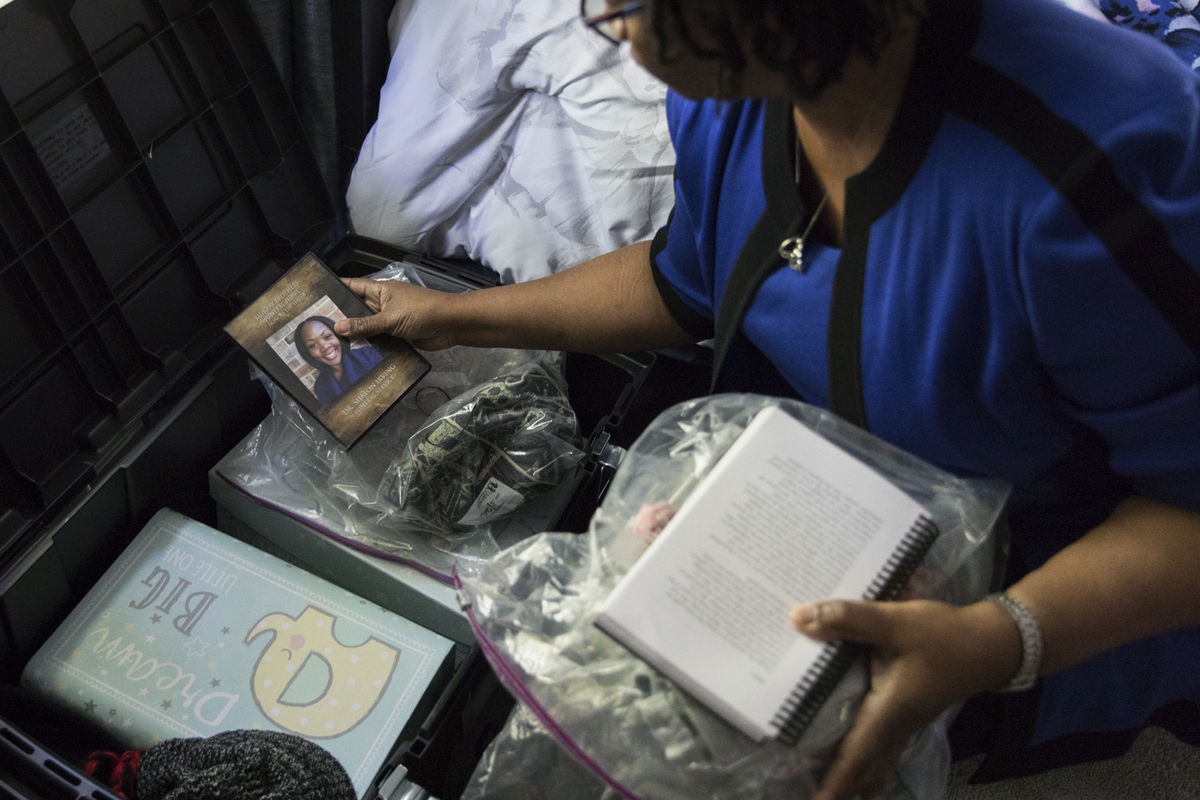
Wanda Irving holds a photograph from the funeral of her late daughter Shalon Irving every bit she goes through a trunk total of her mementos and possessions. She plans to go on the trunk for when her granddaughter Soleil gets older.
Becky Harlan/NPR
Over and over, black women told of medical providers who equated existence African-American with being poor, uneducated, noncompliant and unworthy. "Sometimes you just know in your basic when someone feels contempt for you based on your race," said 1 Brooklyn, Due north.Y., woman who took to bringing her white married man or in-laws to every prenatal visit. Hakima Payne, a female parent of nine in Kansas City, Mo., who used to exist a labor and delivery nurse and still attends births as a midwife-doula, has seen this cultural carve up equally both patient and caregiver. "The nursing civilisation is white, eye-class and female, so is largely built around that identity. Anything that doesn't fit that identity is suspect," she said. Payne, who lectures on unconscious bias for professional person organizations, recalled "the conversations that took place behind the nurse'due south station that simply made assumptions; a lot of victim-blaming — 'If those people would only do blah, apathetic, blah, things would exist different.' "
In a survey conducted this year by NPR, the Robert Wood Johnson Foundation and the Harvard T.H. Chan School of Public Health, 33 percent of black women said that they personally had been discriminated against because of their race when going to a doctor or wellness clinic, and 21 per centum said they have avoided going to a physician or seeking health care out of concern they would be racially discriminated against.
Blackness expectant and new mothers frequently said that doctors and nurses didn't take their pain seriously — a phenomenon borne out by numerous studies that show pain is often undertreated in black patients for weather condition from appendicitis to cancer. When Patrisse Cullors, a co-founder of the Blackness Lives Thing movement who has become an activist to improve black maternal care, had an emergency C-section in Los Angeles in March 2016, the surgeon "never explained what he was doing to me," she said. The hurting medication didn't work: "My mother basically had to scream at the doctors to give me the proper hurting meds."
But it's the discrimination that black women experience in the rest of their lives — the double whammy of race and gender — that may ultimately be the most significant factor in poor maternal outcomes.

Shalon posed in the nursery while pregnant with Soleil. Courtesy of Wanda Irving hide explanation
toggle explanation
Courtesy of Wanda Irving

Shalon posed in the nursery while significant with Soleil.
Courtesy of Wanda Irving
"It'south chronic stress that just happens all the time — at that place is never a period where in that location'south residue from it. It'south everywhere; it's in the air; it's merely affecting everything," said Fleda Mask Jackson, an Atlanta researcher who focuses on birth outcomes for middle-class black women.
It's a type of stress for which education and class provide no protection. "When y'all interview these doctors and lawyers and business executives, when you interview African-American college graduates, it'due south not like their lives have been a walk in the park," said Michael Lu, a longtime disparities researcher and former head of the Maternal and Kid Health Bureau of the Health Resource and Services Assistants, the master federal agency funding programs for mothers and infants. "Information technology'due south the experience of having to work harder than anybody else just to get equal pay and equal respect. It'southward existence followed around when you're shopping at a nice store, or existence stopped by the police force when you lot're driving in a nice neighborhood."
An expanding field of inquiry shows that the stress of being a black adult female in American club can have a physical toll during pregnancy and childbirth.
Chronic stress "puts the body into overdrive," Lu said. "Information technology'southward the aforementioned idea as if you keep gunning the engine, that sooner or later y'all're going to article of clothing out the engine."
Arline Geronimus, a professor at the University of Michigan School of Public Health, coined the term "weathering" for stress-induced wear and tear on the torso. Weathering "causes a lot of different health vulnerabilities and increases susceptibility to infection," she said, "but as well early on onset of chronic diseases, in particular, hypertension and diabetes" — atmospheric condition that disproportionately bear upon blacks at much younger ages than whites. Her research even suggests it accelerates aging at the molecular level; in a 2010 study Geronimus and colleagues conducted, the telomeres (chromosomal markers of aging) of black women in their 40s and 50s appeared 7 i/2 years older on average than those of whites.
Weathering has profound implications for pregnancy, the about physiologically complex and emotionally vulnerable time in a adult female's life. Stress has been linked to one of the most common and consequential pregnancy complications, preterm nativity. Blackness women are 49 percent more probable than whites to deliver prematurely (and, closely related, black infants are twice as probable as white babies to die before their outset birthday). Here again, income and education aren't protective.
The repercussions for the mother's health are also far-reaching. Maternal age is an important risk factor for many severe complications, including pre-eclampsia, or pregnancy-induced hypertension. "Equally women become older, birth outcomes get worse," Lu said. "If that happens in the 40s for white women, information technology really starts to happen for African-American women in their 30s."
This means that for black women, the risks for pregnancy showtime at an before age than many clinicians — and women— realize, and the effects on their bodies may be much greater than for white women. In Geronimus' view, "a blackness adult female of whatever social class, equally early as her mid-20s should be attended to differently."
That's a concept that professional organizations and providers have barely begun to wrap their heads around. "There may be individual doctors or hospitals that are doing information technology [bookkeeping for the college risk of black women], but ... there's non much of that going on," Lu said. Should doctors and clinicians exist taking into account this added layer of vulnerability? "Yep," Lu said. "I truly think they should."

A framed photograph of Shalon in uniform hangs on the wall in her habitation. She worked at the Centers for Disease Control and Prevention in Atlanta, studying how social determinants like food deserts tin can bear on one'southward health. Becky Harlan/NPR hibernate caption
toggle caption
Becky Harlan/NPR

A framed photograph of Shalon in uniform hangs on the wall in her home. She worked at the Centers for Disease Control and Prevention in Atlanta, studying how social determinants like food deserts can affect one'due south health.
Becky Harlan/NPR
A high-pressure life
Shalon Irving's history is virtually a textbook instance of the kinds of strains and stresses that brand loftier-achieving black women vulnerable to poor health. The child of two Dartmouth graduates, she grew upwards in Portland, Ore., where her male parent's father was pastor of a black church. Even in its current liberal incarnation, Portland is one of the whitest large cities in the U.Due south., in part a vestige of the state'due south founding by Confederate sympathizers who wrote exclusion of blacks into their constitution.
Thirty years ago, Portland was a much more uncomfortable place to be blackness. African-American life at that place was oftentimes characterized past social isolation, which Geronimus' research has shown to be particularly stressful. Her father, Samuel Irving, spent years working for the railroad and later on for the urban center but felt his prospects were express past his race. Her mother, Wanda Irving, held various jobs in marketing and communications, including at the U.S. Forest Service. In elementary school, Shalon was sometimes the merely African-American child in her course. "There were many mornings where she would stand up outside banging on the door wanting to come back into the house considering she didn't desire to go to school," her mother recently recalled.
Shalon's strategy for fitting in was to be smarter than everyone else. She read voraciously, wrote a column for a black-owned weekly paper, and skipped a grade. Books and writing helped her cope with trauma and sorrow — first the death of her 20-month-former brother Simone in a auto blow when she was 6, so the fracturing of her parents' marriage, then the diagnosis of her beloved older brother, Sam Iii, with a virulent form of early-onset multiple sclerosis when he was 17. Amid all the family troubles, Shalon was funny and driven, with a fierce sense of loyalty and "a moral compass that was astonishing," her mother said.
She was also overweight and oftentimes anxious, given to daydreaming (equally she later put it) near "alternative realities where people hadn't died and things had not been lost." When it came time to go away to college, she chose the historically black Hampton University in Virginia. "She wanted to feel that nurturing environment," Wanda said. "She had had enough."
By so, Shalon had noticed that many of her relatives —her female parent'due south mother, her aunts, her far-flung cousins — had died in their 30s and 40s. Her brother Sam III sardonically joked that the family had a "death gene," but Shalon didn't think that was funny. "She didn't understand why at that place was such a disparity with other families that had all these long lives," Wanda said. Shalon nagged her begetter to cease smoking and her mother to lose weight. She set an example, shedding almost 100 pounds while managing to graduate summa cum laude. At the start of graduate school at Purdue University, she was a svelte 138 pounds, "very classy and elegant, a lot like her mom," said Bianca Pryor, a master'due south student in consumer behavior who became one of her closest friends.

Bianca Pryor, a Bronx-based consumer behavior researcher, became lifelong friends with Shalon. They were pregnant at the aforementioned time. Melissa Bunni Elian for ProPublica hide caption
toggle caption
Melissa Bunni Elian for ProPublica
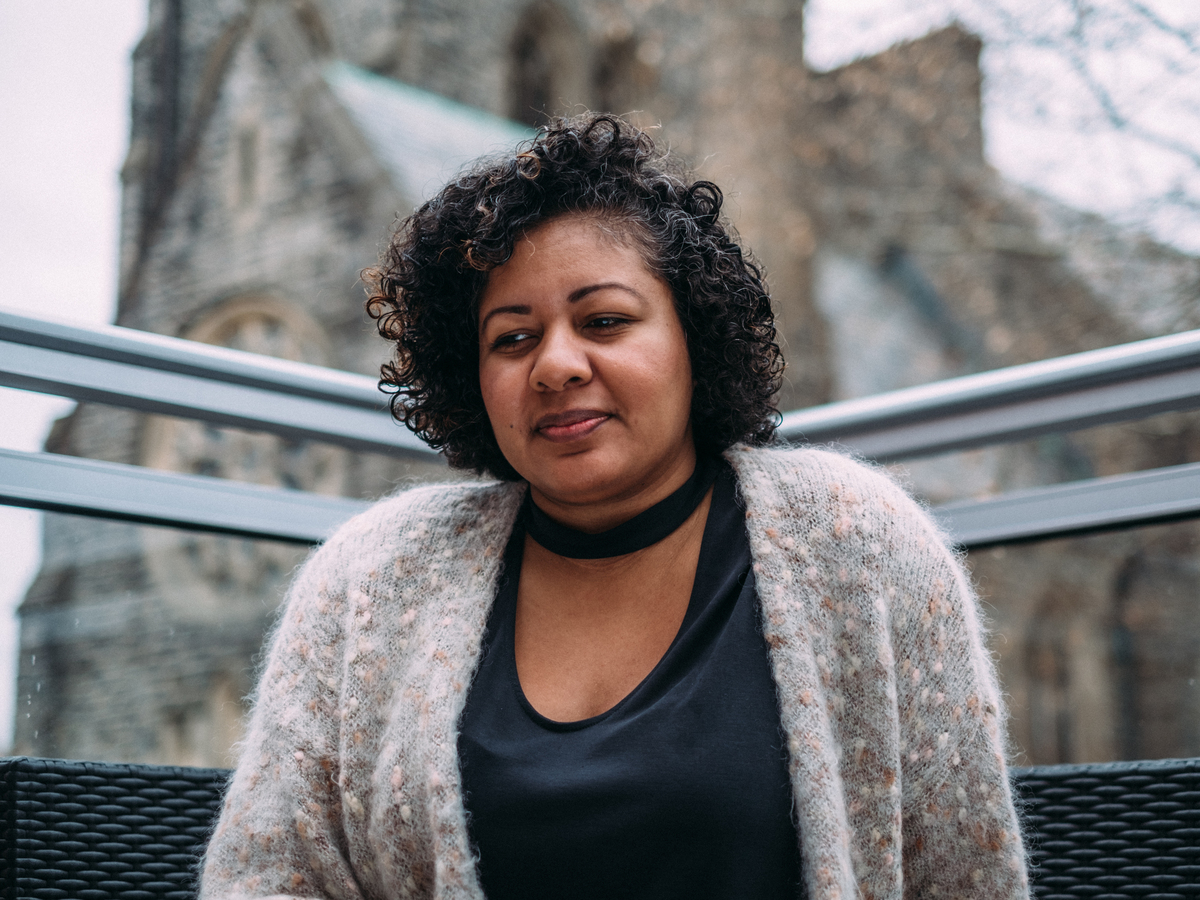
Bianca Pryor, a Bronx-based consumer beliefs researcher, became lifelong friends with Shalon. They were meaning at the same fourth dimension.
Melissa Bunni Elian for ProPublica
Due west Lafayette, Ind., felt as white as Portland. For support, Shalon relied on a cherished circle of "sister friends," as she called them. "There's this feeling that nosotros're carrying the expectations of generations, the kickoff ones trying to climb the corporate ladder, trying to climb in academe," Pryor said. "In that location is this idea that nosotros accept to work twice every bit hard every bit everyone else. Only there's also, 'I'grand first-generation; I don't know the ropes; I don't how to use my social upper-case letter.' There's a bit of shame in that ... this constant checking in with yourself — am I doing this right?"
Much of Shalon's pressure was cocky-imposed: She was pursuing a double Ph.D. in sociology and gerontology, focusing on themes she would render to frequently — the long-term effects of early-childhood trauma and maltreatment, the bear on of the parent-child relationship on lifelong wellness. She finished in under v years, once again with highest honors — "one of the best writers I've had in my academic career," her adviser, sociologist Kenneth Ferraro, said.
Next, Shalon decided to pursue a second principal'due south degree, this time from Johns Hopkins. She was besides juggling family responsibilities. Wanda had followed Shalon effectually the country, working in nonprofit management. "They were like the Gilmore Girls," Pryor said. In 2008, Sam III joined them in Baltimore to take role in a report for an experimental MS therapy. With his family'south back up, he had managed to finish college and run a verse-slam nonprofit for kids. His next goal was to walk across the stage to receive his diploma instead of using his wheelchair. In February 2009, while he was doing physical rehab to regain strength in his legs, a blood clot traveled to his lung, killing him at the historic period of 32. Afterward, Wanda and Shalon clung to each other more tightly than ever.

Wanda and Shalon were so close, "they were like the Gilmore Girls," one friend said. Courtesy of Wanda Irving hide explanation
toggle caption
Courtesy of Wanda Irving
What Shalon wasn't prepared for was how unfulfilled she was. Afterwards Johns Hopkins, she had worked on the forepart lines helping at-chance infants, teenage girls, and mothers with HIV/AIDS. She was passionate virtually improving food and housing security to reduce people's take chances for high blood pressure and other cardiovascular issues. At the CDC, it bothered her that she rarely met the people behind the data she was analyzing. As a consultant for Michelle Obama's anti-obesity initiative Let'south Movement! "she might run across the numbers, only I don't think she actually saw that niggling girl or little male child have a healthier luncheon," Pryor said.
The stress and frustration triggered the old corrosive self-doubts. Just gradually, Shalon saw a manner out of the box. She joined the CDC's Partition of Violence Prevention, refocusing on issues around trauma and domestic abuse — a mission she saw as "liberating" for African-American women, Wanda said. She started a coaching business concern called Inclusivity Standard to advise young people from disadvantaged backgrounds who wanted to get into higher or grad school and organizations seeking to become more diverse. And she decided to write a self-aid book, on the theory that many people in the communities she cared about couldn't afford psychotherapy or didn't trust it. "She was i of those people — one thing is only not enough," said her co-author, Habiba Tran, a therapist and life coach with a multicultural clientele. "One modality is only not enough. One way of [reaching people] is just not plenty."

"No words take been created to adequately capture the fear and dearest and excitement that I experience correct now," Shalon, shown here with her puppy, Lady Twenty-four hour period, wrote to her girl. Courtesy of Wanda Irving hide caption
toggle caption
Courtesy of Wanda Irving

"No words have been created to adequately capture the fearfulness and dearest and excitement that I feel right at present," Shalon, shown here with her puppy, Lady Day, wrote to her daughter.
Courtesy of Wanda Irving
Becoming a mother
Shalon couldn't remember a time when she didn't want to be a mother. But her romantic life had been a "xx-year dating debacle," she admitted in the manuscript of her self-aid book, in role because "I am deathly scared of heartbreak and disappointment, and letting people in comes with the very real risk of both."
In 2014, when Shalon was 34, medical issues forced the issue. For years she had been suffering from uterine fibroids — nonmalignant tumors that affect upwardly to 80 percent of blackness women, leading to heavy menstrual bleeding, anemia and pelvic pain. No one knows what causes fibroids or why blacks are and so susceptible. What is known is that the tumors tin can interfere with fertility — indeed, black women are nearly twice every bit likely to have infertility bug equally whites, and when they undergo treatment, there's much less likelihood that the treatments will succeed. Surgery bought her a little time, but her OB/GYN urged her non to delay getting pregnant much longer.
Shalon had spent her developed years defying stereotypes virtually black women; now she wrestled with the reality that by embracing unmarried motherhood, she could become ane. The financial hazard was substantial — she had simply purchased a boondocks house in the quiet Sandy Springs surface area north of Atlanta, and her CDC insurance covered artificial insemination just for wives using their husbands' sperm. In Portland, no i would have blinked an middle at an unmarried professional woman having a child on her own, but in Atlanta, "there is very much a vibe there that things should happen in a certain order," Pryor said. "And Shalon was non having that at all. She was like, 'Nope, this is what it is.' "
The gamble — funded with her parents' assist — ended in a series of devastating failures. In September 2015, in the midst of an unsuccessful fertility handling, Shalon was alarmed to observe that her right arm had go swollen and hard. Doctors institute a blood jell and diagnosed her with Gene V Leiden, a genetic mutation that makes blood prone to abnormal clumping. Suddenly a office of the family'due south medical mystery was solved. Wanda's mother had died of a pulmonary embolism; so had Sam 3; so had other members of their extended family. Just no one had been tested for the mutation, which is primarily associated with European beginnings. Had they known they carried it, mayhap Sam's deadly blood clot could accept been prevented. It was a what-if too painful to dwell on.
Past April 2016, Shalon had given upwardly. She had a new boyfriend and was on her manner to Puerto Rico to help with the CDC'Southward Zika response, working to prevent the spread of the virus to expectant mothers and their unborn babies. At that place, she discovered she'd gotten meaning by accident. Her excitement was tempered by fear that the baby might have contracted Zika, which can crusade microcephaly and other nativity defects. But a barrage of medical tests confirmed all was well.
More good news: A few weeks later, her friend Pryor learned she was meaning, too. "All right," she told Shalon, "let's finally become afterwards our rainbows and unicorns! Because for so long it was just nighttime clouds and rain."

Bianca and her i-twelvemonth-one-time son, Everton, in her Bronx, North.Y., apartment. Bianca had her own pregnancy emergency; Everton was born at just 24 weeks. Melissa Bunni Elian for ProPublica hide explanation
toggle caption
Melissa Bunni Elian for ProPublica

Bianca and her 1-year-old son, Everton, in her Bronx, N.Y., apartment. Bianca had her own pregnancy emergency; Everton was born at just 24 weeks.
Melissa Bunni Elian for ProPublica
In reality, Shalon's many chance factors — including her clotting disorder, her coarse surgery, the 36 years of wear and tear on her telomeres, her weight — boded a challenging nine months. She also had a history of high claret force per unit area, though it was at present under command without medication. "If I was the doctor taking care of her, I'd be like, 'Oh, this is going to be a tough ane,' " her OB/GYN friend McDonald-Mosley said.
Shalon got through the physical challenges surprisingly well. Her team at Emory University, 1 of the premier wellness systems in the S, had no problem managing her clotting disorder with the claret thinner Lovenox. They worried that scarring from the fibroid surgery could result in a rupture if her uterus stretched too much, and then they scheduled a C-section at 37 weeks. At several points, Shalon'south claret force per unit area did fasten, Wanda said, but doctors ruled out pre-eclampsia and the numbers e'er fell back to normal.
Wanda blamed stress. In that location was the painful end to Shalon's romance with her babe'south male parent and her dashed hopes of raising their child together. There were worries nearly money and panic attacks well-nigh the difficulties of existence a black single female parent in the South in the era of Trayvon Martin and Tamir Rice. Shalon told everyone she was hoping for a girl.
Steeped in research about how social support could buffer confronting stress and adversity, Shalon joined online groups for single mothers and assembled a stalwart community she could quickly deploy for assistance. "She was all near the village," Njai, her CDC mentor, said. "She'd say, 'I'm making sure that when I have my infant, the village is activated and ready to go.' "
She poured more of her anxious energy into finishing the first draft of the book. She sent Tran the manuscript on Jan. 2, the day before the planned C-department, then typed one concluding note to her child. Boy or girl, its nickname would exist Sunny, in honor of her brother Sam, her "sunshine." "You will ever exist my most important achievement," she wrote. "No words accept been created to fairly capture the fearfulness and dearest and excitement that I experience right now."

A photograph of Shalon with newborn daughter Soleil and mother Wanda is displayed on a shelf in Shalon's home side by side to the stuffed monkey that was given to Soleil in the hospital afterwards she was born. Becky Harlan/NPR hibernate caption
toggle caption
Becky Harlan/NPR

A photograph of Shalon with newborn daughter Soleil and mother Wanda is displayed on a shelf in Shalon's habitation next to the blimp monkey that was given to Soleil in the infirmary after she was born.
Becky Harlan/NPR
Sporadic postpartum care
Until recently, much of the word about maternal mortality has focused on pregnancy and childbirth. But according to the nigh recent CDC information, more than half of maternal deaths occur in the postpartum menstruum, and 1-third happen seven or more than days after delivery. For American women in full general, postpartum care tin can be dangerously inadequate — often no more than than a single date 4 to vi weeks after going home.
"If you've had a cesarean delivery, if you've had pre-eclampsia, if you lot've had gestational diabetes or diabetes, if you become abode on an anticoagulant — all those women demand to exist seen significantly sooner than 6 weeks," said Haywood Brown, a professor at Duke University medical schoolhouse. Dark-brown has made reforming postpartum intendance one of his main initiatives as president of the American Congress of Obstetricians and Gynecologists.
The dangers of sporadic postpartum care may be specially dandy for black mothers. African-Americans have college rates of C-section and are more than twice as likely to be readmitted to the hospital in the month following the surgery. They have disproportionate rates of hypertensive disorders and peripartum cardiomyopathy (pregnancy-induced heart failure), two leading killers in the days and weeks after delivery. They're twice as likely as white women to have postpartum depression, which contributes to poor outcomes, simply they are much less probable to receive mental wellness treatment.
If they experience discrimination or disrespect during pregnancy or childbirth, they are more than probable to skip postpartum visits to cheque on their ain health (they do continue pediatrician appointments for their babies). In one study published earlier this year, 2-thirds of low-income black women never made it to their doctor visit.
Meanwhile, many providers wrongly presume that the risks finish when the baby is built-in — and that women who came through pregnancy and commitment without bug volition stay healthy. In the case of black women, providers may non understand their true biological risks or evaluate those risks in a large-motion picture style. "The maternal feel isn't over right at delivery. All of the due diligence that gets applied during the prenatal flow needs to go on into the postpartum flow," said Eleni Tsigas, executive director of the Preeclampsia Foundation.
Information technology'due south not just doctors and nurses who need to think differently. Like a lot of expectant mothers, Shalon had an elaborate plan for how she wanted to give nascency, even including what she wanted her surgical team to talk about (naught political) and who would announce the babe's gender (her female parent, not a medico or nurse). But like most pregnant women, she didn't have a postpartum intendance plan. "It was just trusting in the system that things were gonna go OK," Wanda said. "And that if something came upwardly, she'd be able to handle information technology."
The birth was "a beautiful time," Wanda said. Shalon did and then well that she persuaded her doc to permit her and Soleil — French for "sun" — leave the infirmary afterwards ii nights (three or iv nights are more typical). And so at home, "things got existent," Pryor said. "Information technology was Shalon and her mom trying to figure things out, and the late nights, and trying to become infant on schedule. Shalon was very honest. She told me, 'Friend, this is hard.' "
C-sections have much higher complication rates than vaginal births. In Shalon's case, the trouble — a painful lump on her incision — started a calendar week later she went habitation. The first dr. she saw, on Jan. 12, said information technology was nothing, but every bit she and her female parent were leaving his office, they ran into her regular OB/GYN, Elizabeth Collins, whom Shalon trusted completely. Collins took a await and diagnosed a hematoma — blood trapped in layers of healing skin, something that happens in about i percent of C-sections. She drained the "fluctuant mass" (every bit her notes described it), and "copious bloody non-purulent material" poured out from the 1-inch incision. Collins also bundled for a visiting nurse to come past the house every other twenty-four hours to modify the dressing.
What troubled the nurse virtually, though, was Shalon's blood pressure. On Jan. 16 it was 158/100, loftier enough to raise concerns almost postpartum pre-eclampsia, which can lead to seizures and stroke. Only Shalon didn't have other symptoms, such as headache or blurred vision. She made an appointment to run across the OB/GYN for the next twenty-four hours, then concluded up being too overwhelmed to go, the visiting nurse noted on Jan. 18. In that same record, the nurse wrote that Shalon had to alter the dressing on her wound "sometimes several times a 24-hour interval due to large amounts of red drainage. This is calculation to her stress as a new mom." Her pain was 5 on a scale of 10, preventing her from "sleeping/relaxing." Overall, Shalon told the nurse, "it simply doesn't feel correct." When the nurse measured her blood pressure on the cuff Shalon kept at home, the reading was 158/112. On the nurse'due south equipment, the reading was 174/118.
Under electric current ACOG guidelines, those readings were high enough to warrant more than aggressive action, Tsigas said, such as an immediate trip to the dr. for further evaluation, possibly medication, and more careful monitoring. That is peculiarly true for someone with a history of hypertension and multiple other risks. "We need to look holistically at the gamble factors irrespective of whether or not she had a diagnosis of pre-eclampsia," Tsigas said. "If somebody has a whole plateful of gamble factors, how are you treating them differently?"
"It would have made sense to admit her to the hospital for a consummate work-up," including chest X-ray, an echocardiogram to evaluate for centre failure, and titration of her medication to get her blood pressure to normal range, wrote ane doctor, a leading good on postpartum care, who agreed to look at Shalon's records at ProPublica's request simply asked not to be identified. The doctor said that the communication about signs of stroke seemed insufficient and that information technology would be more "common practice" to assess her that day to discover out what was wrong.
Instead, Shalon was given an appointment for the next day, Jan. 19, with an OB/GYN at Women's Middle at Emory St. Joseph'due south, which handled her primary intendance. By then, Shalon's blood pressure level had fallen to 130/85 — considered on the loftier finish of normal — and there were "no symptoms concerning for postpartum [pre-eclampsia]," the doctor wrote in his notes. He wrote that Shalon was healing "appropriately" and thought her jumps in blood force per unit area were likely related to "poor pain control." Wanda and Shalon left feeling more than frustrated than ever.
At home over the next couple of days, Wanda noticed that ane of Shalon's legs was larger than the other. "She said, 'Yes, I know, Mom, and my genu hurts, I tin't bend information technology.' "
When McDonald-Mosley looked over the voluminous medical records a few months later, what jumped out at her was the sense that Shalon'southward caregivers (who declined to comment for this story) didn't seem to recollect of her as a patient who needed a heightened level of attention, despite the complexity of her pregnancy.
"She had all these risk factors. If you're gonna selection someone who's going to accept a problem, it's gonna be her. ... She needs to be treated with caution." The fact that her symptoms defied piece of cake categorization was all the more reason to be vigilant, McDonald-Mosley said. "At that place were all these opportunities to identify that something was going wrong. To act on them sooner and they were missed. At multiple levels. At multiple parts of the health care organization. They were missed."
Shalon's other friends were growing uneasy, too. Pryor had her own pregnancy emergency — her son was born very prematurely, at 24 weeks — so she couldn't be in Atlanta. Merely she and Shalon talked often by phone. "She knew then much about her body i would call up she was an 1000.D. and not a Ph.D. To hear her be concerned almost her legs — that worried me." Pryor encouraged her, " 'Friend, are you lot getting out of the firm? Are you going for your walks?' She told me, 'No, I'g on my chaise lounge, and that'south about every bit much every bit I can practise.' "
Life bus Tran was so upset at Shalon'due south condition that she took her frustrations out on her friend. "I was cussing her out. 'Go to the f****** doctor.' She's like, 'I chosen them. I talked to them. I went to run across them. Get off my back.' "

Shalon took this selfie with her father, Samuel, and Soleil on the forenoon of Jan. 24. Twelve hours later, she collapsed. Courtesy of Wanda Irving hide caption
toggle explanation
Courtesy of Wanda Irving
"There is something incorrect"
On the forenoon of Tuesday, Jan. 24, Shalon took a selfie with her father, who had been visiting for a few days, and so sent him to the airport to catch a flight back to Portland. Toward noon, she and Wanda and the infant drove to the Emory Women'southward Centre one more time. This time, Shalon saw a nurse practitioner. "We said, 'Wait, there's something wrong here; she's not feeling well,' " Wanda recalled. " '1 leg is larger than the other; she'southward even so gaining weight — 9 pounds in 10 days — the blood pressure is still up. There's gotta be something wrong.' "
The nurse's notes confirmed Shalon had swelling in both legs, with more swelling in the correct one. She noted that Shalon had complained of "some mild headaches" but didn't have other worrisome symptoms, like blurred vision. She checked the incision — "warm dry out no [sign/symptom] of infection" — and noted Shalon'due south mental state ("cooperative, advisable mood & bear on, normal judgment").
" 'Y'all guys accept to realize she merely had a baby. Don't worry almost it, things are calming down,' " Wanda recalled the nurse telling them. " 'We'll send her downwardly for an ultrasound to meet if she has a clot in her leg.' " Shalon's blood pressure was back upwardly to 163/99, so the nurse besides ordered a pre-eclampsia screening.
Both tests came back negative. "So they're saying, 'Well if there'due south no clots, there'south nothing wrong,' " Wanda recalled. As Wanda remembers it, Shalon was insistent: "There is something incorrect, I know my body. I don't experience well, my legs are swollen, I'thou gaining weight. I'thousand not voiding. I'm drinking a lot of water, but I'm retaining the water." Equally Wanda recalls it, the nurse told them, "There is cipher we can practice; y'all only have to wait, requite it more time." Before sending Shalon home, the nurse gave her a prescription for the blood pressure medication nifedipine, which is often used to treat pregnancy-related hypertension.

A large, framed photograph of newborn Soleil and female parent Shalon hangs in Soleil'due south nursery. Shalon painted the nursery light bluish soon before Soleil was built-in. Becky Harlan/NPR hide caption
toggle caption
Becky Harlan/NPR
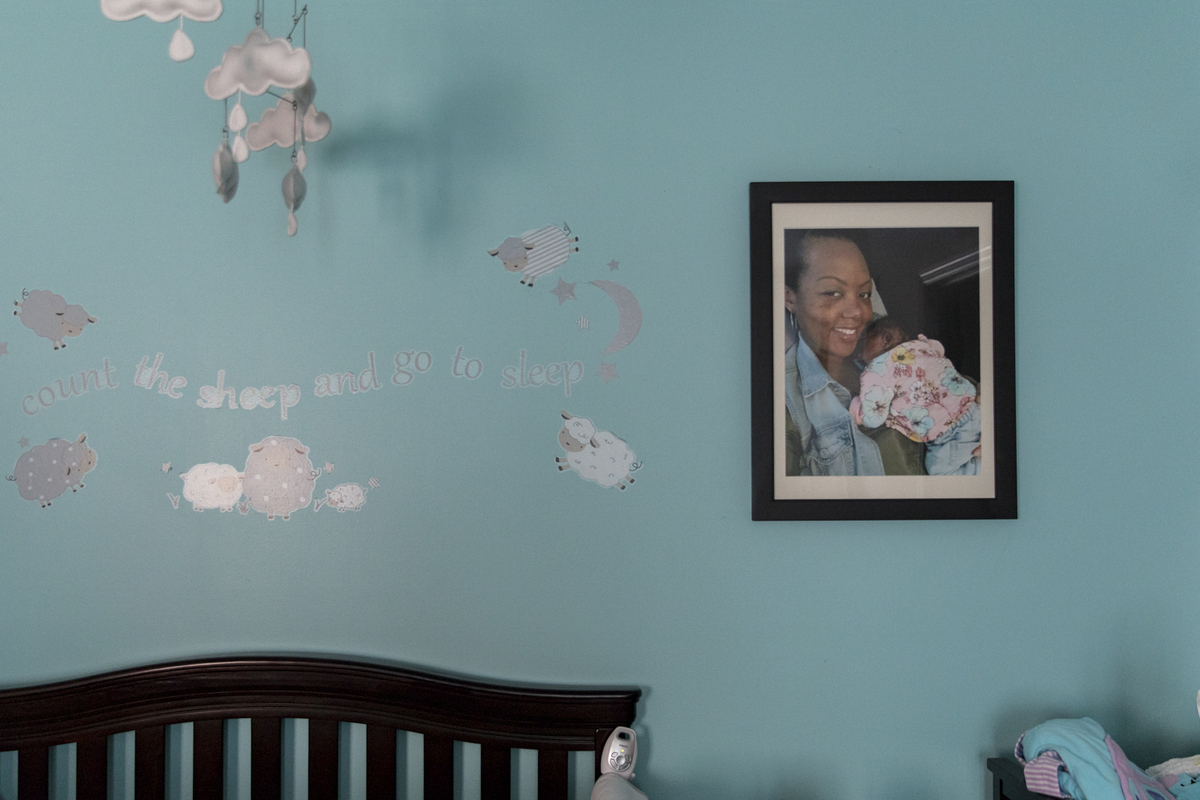
A large, framed photo of newborn Soleil and mother Shalon hangs in Soleil's nursery. Shalon painted the nursery calorie-free blue shortly before Soleil was built-in.
Becky Harlan/NPR
Shalon and Wanda stopped at the chemist's shop, then decided to get out to dinner with the baby. While they ate, they talked about a trip Shalon had planned for the 3 of them to take in just a few weeks. Ever since Sam Three had died, Wanda and Shalon had made a signal of traveling someplace special on painful anniversaries. To marker his 40th birthday and the eighth anniversary of his death, Shalon had gotten the idea of going to Dubai. ("It'southward cheap," Shalon had told Wanda. "The money is worth then much more at that place. Information technology's supposed to be beautiful.") She had long ago purchased their tickets and ordered the babe's passport. At present Wanda was worried — would she exist feeling well enough to make such a big trip with an infant? Shalon wasn't willing to requite up promise only nevertheless. Wanda recalls her maxim, "I'll be fine, I'll be fine."
They got home and sat in Shalon's chamber for a while, laughing and playing with the baby. Around 8:30 p.m., Shalon suddenly declared, "I just don't know, Mom, I just don't feel well." She took the blood pressure medication from Wanda and got ready for bed. An hour subsequently, Wanda heard a terrifying gasping noise. Shalon had complanate.
The news spread quickly amidst her colleagues at the CDC. William Callaghan, main of the maternal and infant wellness co-operative, recalled in March that his boss, who had visited Shalon at the hospital, chosen to let him know. "It was a chilling phone call," said Callaghan, ane of the nation's leading researchers on maternal mortality. "It certainly takes, in that moment, what I do, it made it very, very, very concrete. ... This was non about data, this was not about whether information technology was going up or it was going down. It was nigh this tragic event that happened to this adult female, her family."
Northside decided against an dissection, telling Wanda and Samuel that there was zippo unusual nearly Shalon's expiry, they recalled. (The hospital declined to annotate.) So Wanda paid $4,500 for an autopsy by the medical examiners in neighboring DeKalb County. The report came dorsum three months later. Noting that Shalon'southward heart showed signs of damage consistent with hypertension, information technology attributed her death to complications of loftier claret pressure.

Soleil plays with her nanny. Becky Harlan/NPR hide caption
toggle caption
Becky Harlan/NPR
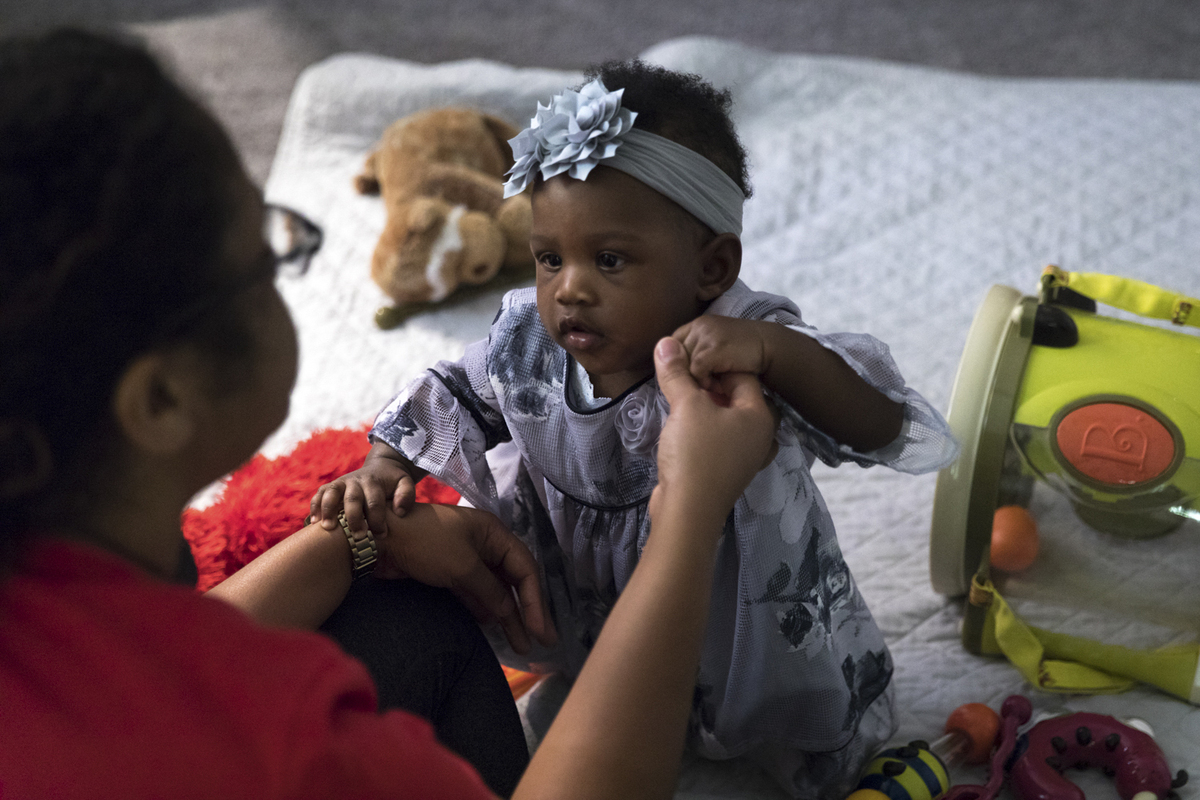
Soleil plays with her nanny.
Becky Harlan/NPR
Raising Soleil
Wanda moved into Shalon's tidy town firm to intendance for Soleil. Even though Shalon'south villagers fulfilled their pledges at the memorial service, coming past ofttimes to give Wanda a break, the start months were borderline unbearable — the babe was colicky, prone to gastric bug that kept both of them upward all dark. Wanda'southward grief was endless, bottomless, merely she couldn't let it interfere with her duties to Soleil. "She's the merely reason I get up every forenoon, pretty much," Wanda said.
Eventually the colic went away and Soleil thrived. In June, Wanda and her 5-calendar month-old granddaughter collection to Chattanooga, Tenn., for the annual meeting of U.S. Public Health Service scientists. A new honor — the Shalon Irving Memorial (Inferior) Scientist Officer of the Year Accolade — had been created to celebrate Shalon's legacy, and Wanda had been asked to say a few words. She handed the infant to one of Shalon's CDC colleagues and took the small stage.
"Striving for excellence is a selection," she told the audience through barely suppressed tears. "It is a commitment. ... It's a struggle to become the person you want to be. It's harder than yous want. It takes longer than you desire. And it takes more out of you than you expected it should."
Shalon personified excellence, Wanda said. "I don't know if Shalon became the woman that she ultimately wanted to be. Just I do know that she wanted to exist the woman she was."

Wanda holds Soleil's easily as she learns to walk. Becky Harlan/NPR hide explanation
toggle explanation
Becky Harlan/NPR

Wanda holds Soleil's easily as she learns to walk.
Becky Harlan/NPR
One Saturday afternoon in October, Wanda received a volume that friends of Shalon's from the Epidemic Intelligence Service had compiled, titled Letters to Soleil. She put Soleil on her lap and said, "I'm gonna read yous some letters virtually your mom." One affair Wanda has tried never to practice is cry in front of Soleil. But as she began reading the letters, she was sobbing. "And Soleil just kept looking at me — she couldn't understand what was going on. And about a minute after she took my glasses off with her hands and put them downwardly and then laid her head right on my chest and started patting me. Which made me cry all the more."
As Soleil got older, Wanda looked forward to doing the kinds of things with her that Shalon had looked forrard to: reading to her, traveling with her, taking her to gymnastics and music classes. "She wanted Soleil to go to Montessori school, so I'm looking for a Montessori school for her," Wanda said. "She wanted her to be christened; nosotros got her christened."
Now 10 months sometime, Soleil has her mother's eyes, energy and headstrong withal sweet disposition, coming into Wanda's bed every night and waking her early to play. "She'll bite my nose and kick me — 'Nana, time to go up! Time to get up!' That'southward what keeps me motivated."
A week or so later the memorial service, Wanda came across a letter of the alphabet that Shalon had written to her two years before, around the sixth anniversary of Sam III's death. Shalon had left it among the other important items on her calculator, trusting that if something e'er happened to her, Wanda would discover it. The alphabetic character reads similar a premonition: Shalon was contemplating the prospect of her own premature death — and of her love mother having to suffer i more unbearable tragedy.
I am sorry that I have left y'all. On the detail twenty-four hour period that I am writing this I have no idea how that may have occurred but know that I would never choose to leave.
I know it seems impossible right now, merely please do not let this break you. I want you to be happy and smile. I want you to know that I am existence watched after past my brothers and grandma and that we are all watching yous. Please endeavor not to weep. Use your energy instead to experience my honey through time and space. Naught can intermission the bail nosotros have and yous volition forever exist my mommy and I your baby girl!
Death Circle 7 Times When Having a Baby
Source: https://www.npr.org/2017/12/07/568948782/black-mothers-keep-dying-after-giving-birth-shalon-irvings-story-explains-why
0 Response to "Death Circle 7 Times When Having a Baby"
Post a Comment